



Johnston County builds safeguards into every election
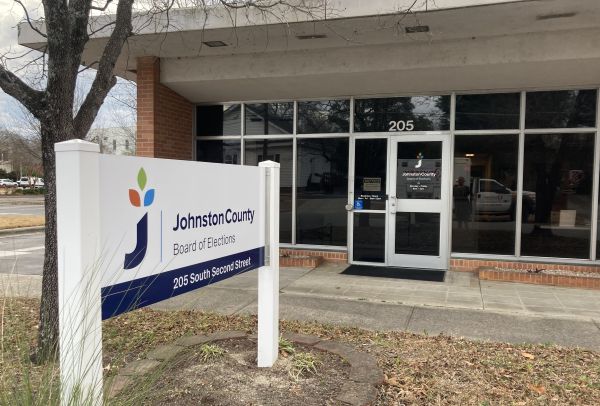 The Johnston County Board of Elections takes multiple steps to ensure election integrity.
SMITHFIELD — In an era when election integrity has become a flashpoint in America, Johnston County Elections Director Leigh Anne Price doesn’t promise perfection.
She won’t tell voters every election is completely accurate or that fraud is impossible.
“I can’t say it’s 100% accurate,” Price said in a recent interview. “I’d be crazy to say it’s 100% accurate.”
What she can promise is that safeguards are in place to ensure every election is as accurate, transparent, and secure as humanly possible.
Testing the machines
“It starts,” Price said, “with the testing of our tabulators,” the machine at every precinct that voters feed their ballot into after casting their votes.
In Johnston, each tabulator is programmed to accept and count ballots only from a particular precinct. A barcode on ballots designates the precinct.
“Every tabulator is tested to make sure it accepts only the ballots it’s supposed to accept,” Price said. “For example, the tabulator assigned to North Boon Hill Precinct has to be tested to make sure it only reads North Boon Hill ballots.”
The test includes feeding ballots from other precincts into the tabulator. “The tabulator spits them right back out and tells you the ballot doesn’t belong to that precinct,” Price said.
That’s one step in the election integrity process.
Verifying the voter
Then, when a person comes into vote, he or she must present a photo ID. “We’re looking at it to make sure the picture resembles the person standing in front of us,” Price said. “It helps us confirm the person voting is the person they claim to be.”
Her office uses every safeguard available to prevent voter fraud. “When someone registers, we verify information such as the last four digits of a Social Security number or a driver’s license number,” Price said. “Our registration system also checks information through federal databases.”
Separately, the federal government will send out alerts when it thinks registered voters might be noncitizens.
Price recalled one such case. “The day before an election, I received notification that three registered voters had been flagged as possible noncitizens,” she said. “We immediately contacted the precincts.”
One of the three showed up at the polls, though she was able to prove her citizenship. “It turned out that she already knew about the issue,” Price said. “She brought all of her citizenship documentation with her, and the problem wasn’t hers at all; it was an error in the federal records.”
But Price won’t say unequivocally that no noncitizen has ever voted in a Johnston County election. “I can only say that we use every tool available to identify problems,” she said.
Like evidence in a police investigation, ballots are subject to a strict chain of custody. “We have to account for what we send out to the precincts and what comes back,” Price said. “Everything has to match.”
The provisional ballot
Some people who try to vote in a Johnston election aren’t registered to vote here. But that doesn’t necessarily suggest a fraud attempt, Price said. “People move from Wake County or somewhere else and think they’re registered here when they’re not,” she said.
A precinct doesn’t turn away anyone not on the voter rolls. Instead, it lets them cast a provisional ballot, which goes into a provisional envelope instead of the tabulator. Price’s office later counts the ballot but only if it can confirm that the person is a registered voter here.
“The day after the election, we begin researching every provisional ballot,” Price said. “We determine whether the voter was registered in another county, whether they attempted to register in Johnston County, or whether there was a delay — for example, if DMV registration information hadn't reached us in time.”
Based on that research, Price’s office recommends to the Board of Elections which provisional ballots to count.
As a percentage of all ballots cast, the number is small.
“I think we had a little over 200 provisional ballots during this primary election, and maybe 30 or 40 of those were counted,” Price said.
Checking the numbers — a lot
Every hour on election day, precinct officials compare the number of ballots handed out to the number recorded by the tabulator. If those numbers don’t match, workers immediately begin accounting for every ballot and every voter.
Most often, the explanation is simple, Price said. “It could be someone voting curbside who hasn’t put their ballot into the tabulator yet,” she said.
If the numbers still don’t match, the workers investigate further. “Sometimes a provisional ballot accidentally went into the tabulator when it shouldn’t have,” Price said.
Other times, a precinct worker can get his or her numbers wrong. “Usually what happened is the person numbering the authorization-to-vote form skipped a number or accidentally numbered two forms the same,” Price said, referring to the form that all voters sign before receiving their ballot.
That’s the most likely explanation for a discrepancy in ballots handed out compared to ballots counted. “Nine times out of 10, it’s simply a number mistake,” Price said.
What’s impossible is for one of the tabulators to make a counting or vote-tabulating mistake, she said. “Honestly, these tabulators are smarter than I am,” Price said. “We just don’t have problems with them.”
After the polls close, Price’s staff double-checks each precinct’s numbers. “We compare the hourly count sheets, the number of ballots voted, the tabulator total, and the printed tapes from every precinct,” she said. “We go precinct by precinct to make sure everything matches.”
The state Board of Elections keeps tabs on Johnston’s numbers too, as it does for every county. “After every election, the state sends us reports that we review precinct by precinct,” Price said. “Occasionally, we’ll find that their voter history differs from our totals by just a few votes.”
A third check of the totals usually resolves those discrepancies. “But there have been elections where we still couldn’t account for two or three votes,” Price said. “I honestly don’t know how that happens.”
Which is why she’ll never say any election is 100% accurate. “I’d say 99%,” Price said.
Page last updated on: September 14, 2026