


Johnston County Farm Becomes North Carolina's 100th Preserved Through Conservation Partnership
Born in the 1920s, Ken Langston’s parents grew up on family farms in Johnston and Wayne counties. Later, the couple became the John Deere farm equipment dealers in Smithfield.
Those experiences gave his parents “a front-row seat” to all of the changes taking place in farming, Langston said. “As time progressed, my mother became very concerned about the demise of family farms and the loss of agricultural lands for development,” he told a group gathering on Wednesday.
Over the years, Langston’s mother, Marjorie, had become the owner of three farms, two in Johnston County and one in Wayne County. In December 2021, she began the process of placing all three farms in conservation easements, meaning they would remain in farming forever.
In a conservation easement, a landowner receives payment based on the appraised fair market value of the easement. The easement deed describes the restrictions but supports the agricultural use of the land. The conservation easement deed stays with the land should the owner sell it or pass it to heirs.
“My mother passed away in April 2022 with this work just getting started,” Langston noted.

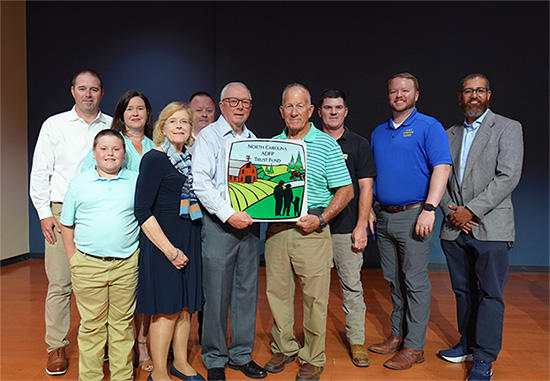
As trustee of the Marjorie D. Langston Trust, Ken Langston took on the task of completing those conservation easements, and on Wednesday, he stated that he made sure his mother’s wishes were fulfilled. Langston said the easements were a good thing. “During this process, I have talked with accountants, attorneys, surveyors, reviewers and numerous interested parties,” he noted. “No one has given me any indication that farmland preservation is a wasted effort or not an admirable, worthy governmental initiative.” The Langston family had placed the other two farms in conservation easements previously.
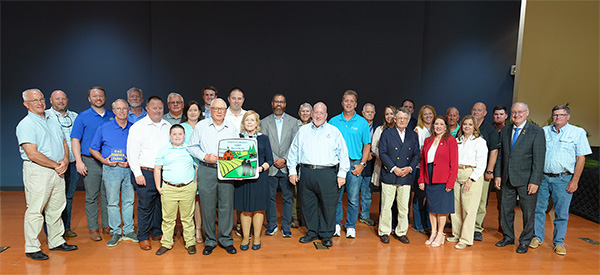
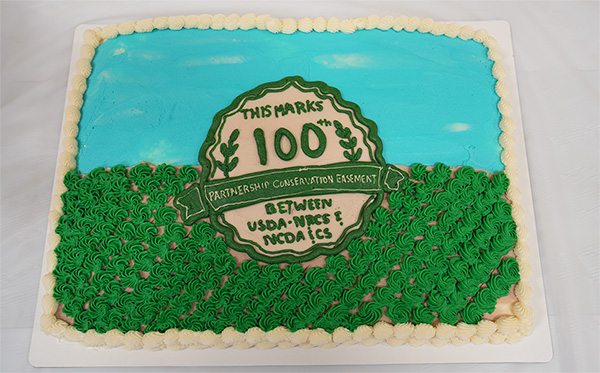
A brief program on Wednesday at the Johnston County Agricultural Center celebrated the conservation easement on the Langston farmland on Swift Creek Road in Johnston County. That easement marked the 100th closed with funding from a partnership between the N.C. Department of Agriculture and the National Resources Conservation Service, which is part of the U.S. Department of Agriculture.
Funds for the purchase of this conservation easement came from a combination of the NCDA and USDA funds and a portion from a landowner donation. The first Langston easement in Johnston County was funded by the NCDA, Johnston County and a portion from the landowner donation. The three farms, to include the one in Wayne County, total 243 acres protected by a conservation easement.
The funding partnership between the NCDA and USDA secured its first conservation easement in 2009 in Durham County, noted Evan Davis, Director of Farmland Preservation for the NCDA. “Over the course of the next 17 years, 99 more partnership conservation easements have been recorded, totaling nearly 17,000 acres of preserved farmland in 32 counties across North Carolina,” he said.
More farmland preservation is on the way, Davis said. “We have accomplished a lot over the years, but we are entering a new era of opportunity,” he said. “Just recently, the state made a historic investment in farmland preservation funding, providing the most funding ever in a single year ($54 million) to the Agricultural Development and Farmland Preservation Trust Fund.”
Ken White is the assistant chief for the South Region of the Natural Resources Conservation Service participated in the event representing the USDA. He equated farmland preservation to stewardship and called it a virtue.
“It’s really close to where all of your other core values reside,” White said. “Integrity, honesty, patriotism — they begin in your heart.”
White praised Marjorie Langston for her decision to keep the family land in farming by saying, “I think that mother had stewardship in her heart and realized the value of the land,” he said.
“There is a proverb out of Africa that says, ‘If you want to go fast, go alone. But if you want to go far, go together,’ ” White said, praising the various agencies that worked together to secure the easements.
The NCDA and the USDA-NRCS are the main funding sources that allow eligible entities such as Johnston Soil and Water Conservation District to plan, purchase and hold the conservation easements that protect farmland. Greg Walker, Director for Johnston Soil and Water Conservation District noted that sometimes resources from the Johnston County Commissioners are needed to complete a final funding package. He wanted to make clear that Commissioner support is vital to our overall success.
Patrick Harris is chairman of the Johnston County Board of Commissioners, which has supported conservation easements financially. “One of our priorities is farmland preservation,” he said. “Agriculture is very important in Johnston County, very important in North Carolina, and any opportunity we have to try to boost that, then we’re always interested in doing that.”