


Budget boosts schools, public safety while cutting tax rate
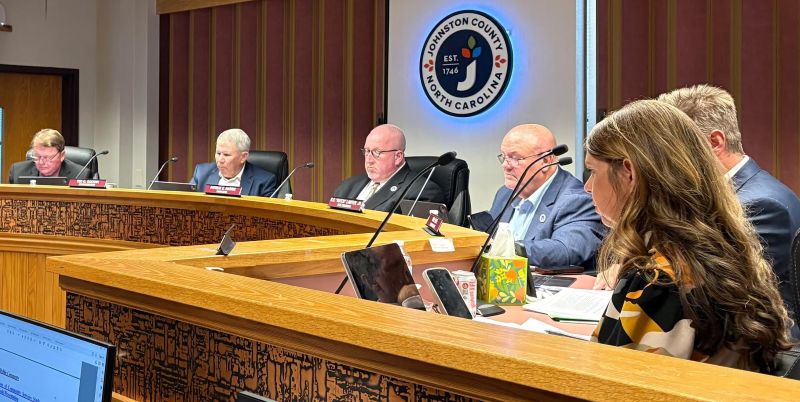 County Commissioners have cut the tax rate a penny while giving more dollars
to the public schools and community college.
SMITHFIELD — The County’s final 2026-27 budget is some $14 million more than County Manager Rick Hester recommended.
Still, it includes a penny tax cut while bolstering the Johnston County Public Schools, Johnston Community College, and public safety.
“This board over the last several years has identified six priorities,” Commissioners Chairman Patrick Harris said in advance of the budget’s adoption on June 15. “I think as we work our way through this budget, you’ll see those priorities incorporated into this.”
Commissioner Butch Lawter ran point on this year’s budget, which gives the public schools all of the dollars they had sought for both operations and capital outlay.
He explained how he arrived at his recommendation to fully fund the schools’ $116.3 million request for operating expenses. “I traditionally have looked at an inflation factor, which I have used 3% this year,” Lawter said. “When I took that and applied the (enrollment) growth they had projected of 0.4%, I was really close to their number.”
Lawter called the schools’ request remarkably reasonable. “I think it was a total of 5% or 5.7% increase,” he said.
The budget also gives the schools the $5,478,000 they had sought for capital outlay.
Lawter said it was time to begin addressing the schools’ backlog of maintenance needs. “On the capital side, we’ve debated for years what the right number is,” he said. “I think we’re moving in the right direction on that.”
The budget gives Johnston Community College roughly $14.6 million for operating expenses, a nearly 53% increase over 2025-26.
Lawter made the case for that increase too, arguing that JCC needed to offer higher pay to recruit and retain employees. Johnston County found itself in a similar position in 2018, he reminded the Board.
“Just as we did, they are trying to stop people from leaving and going to Wake County or somewhere else close by,” Lawter said.
Commissioners Chairman Patrick Harris said the need for higher pay was especially acute in JCC’s health care programs. “We’re teaching nurses to work in hospitals and ICUs and the Health Department, and we can’t hire the nursing instructors because the pay is too low,” he said. “This budget … is going to fix that problem.”
Finally on the spending side, Lawter recommended the budget include most of the new positions that department heads had requested. “Public safety is among our top priorities, and we had requests from the Sheriff’s Department, Emergency Services and others that we felt were critical,” he said.
Lawter and other Commissioners said they wished they could have cut more than a penny from the tax rate, which falls to 51 cents per $100 valuation. But with spending needs and threats from state lawmakers to cap local government revenue, Commissioners erred on the side of caution.
“I see more and more uncertainty on the horizon,” Commissioner Bill Stovall said, pointing to pending legislation in the General Assembly. “They are advancing a constitutional amendment that would limit both property taxes and corporate income taxes, and who in their right mind is going to vote against that?”
Lawter shared Stovall’s unease. “It’s always tough when you’re preparing a budget — the what-ifs,” he said. “What is our growth in revenue going to be? What are our expenses? This year, we had the added complication of what will happen in Raleigh. So a lot of unknowns.”
Commissioner Mike Rose said each penny on Johnston’s tax rate generates about $4.7 million. With a penny cut on the rate, that’s $4.7 million that Johnston’s taxpayers will keep, he said.
“I hope it shows the public that we are taking seriously that it’s the public’s money,” Rose said. “That one penny won’t be a lot to each individual, but it’s $4.7 million the County could probably use somewhere, but we don’t want it if we don’t need it.”
Harris said he judged every budget this way: “I look at the results,” he said.
And Johnston’s annual budgets are producing meaningful results, Harris said. “We had 200 mobile classrooms, and now we’re down to less than 50 in the County,” he said. “That’s results. We’re graduating more young people from Johnston Community College than we have ever. That’s results. That’s changing people’s lives.”
Board promises a better budget process
SMITHFIELD — In recent years, Johnston County Manager Rick Hester has unveiled his recommended budget in early to mid-May.
Next, a single Commissioner has run point on the budget, polling his fellow Commissioners individually about their spending priorities and tax rate preferences.
Then, at a meeting in June, that Commissioner has read a budget motion that makes agreed-upon spending changes and sets a tax rate that’s often below the manager’s recommendation. The motion has typically come with little discussion.
The process, Commissioners concede, is opaque. It will be different next year, they promised as they adopted a 2026-27 County budget.
“It will be more transparent, more open and with more opportunity for citizens to have even more involvement,” Commissioners Chairman Patrick Harris said on June 15. “We’re going to change the procedure from what it’s been, and I think that’s a good thing.”
For one, Commissioners will begin their budget deliberations in April and will do so publicly.
“We’ve heard people ask for transparency, and we are moving to provide that,” said Commissioner Butch Lawter, the Board’s vice chairman. “Next year, when we go to two budget meetings in April, there will be more input; we will have more discussion.”
Commissioner April Stephens said she was looking forward to the change. “We want to make sure that we are being as transparent as possible, we are talking about this as much as possible, listening as much as possible and making sure that the decisions we’re making are what’s best for the county as a whole,” she said.
Page last updated on: July 13, 2026