



Smithfield school was a symbol of freedom
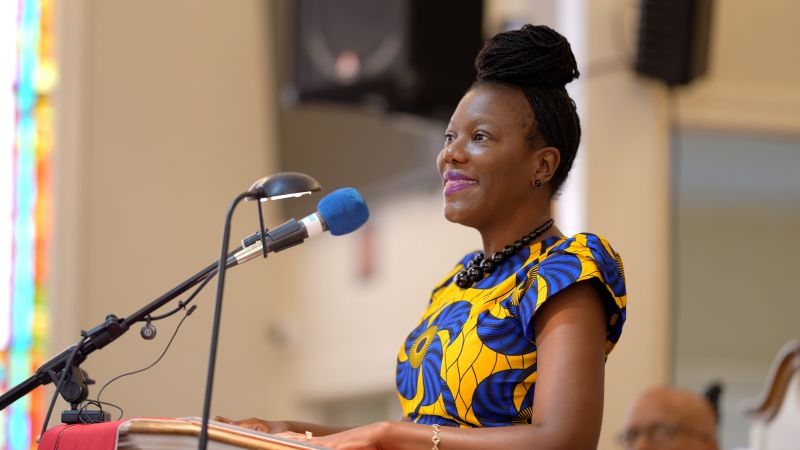 Crystal Sanders, a history professor, speaks during the dedication
of the restored Freedmen's School in Smithfield.
SMITHFIELD — For formerly enslaved people, an education meant freedom.
That was the message Crystal Sanders delivered during the dedication of Smithfield’s restored Freedmen’s School.
Before the Civil War, North Carolina law barred teaching enslaved people to read and write. Lawmakers argued that educating them had a tendency to “excite violence in their minds” and produce “insurrection and rebellion.”
“The law made it illegal to teach enslaved people to read and write or to provide them with books and pamphlets,” Sanders told her audience.
Those who broke the law could face harsh punishments, said Sanders, an associate professor of history at Emory University in Atlanta.
“White people who violated the law could be fined or imprisoned,” she said. “Free Black people who violated the law could be fined, imprisoned, or publicly whipped. Enslaved people … could be punished with 39 lashes on their bare backs.”
Yet some enslaved people learned to read and write despite those risks.
“They were willing to risk everything to gain what slavery had robbed them of,” Sanders said.
After the war, formerly enslaved people pursued education with the same determination. In communities across the South, they built schools and sought opportunities to learn long before outside assistance arrived, Sanders said.
She quoted John Alvord, the national superintendent of schools for the Freedmen’s Bureau: “Throughout the entire South, an effort is being made by the colored people to educate themselves. In the absence of other teaching, they are determined to be self-taught.”
That was the case in Smithfield, Sanders said.
“In January 1866, three white women from the Boston-based New England Freedmen's Aid Society came here to teach in a school that formerly enslaved people had recently built themselves,” she noted. “In other words, white northerners came south to staff a school that local Black people had already created.”
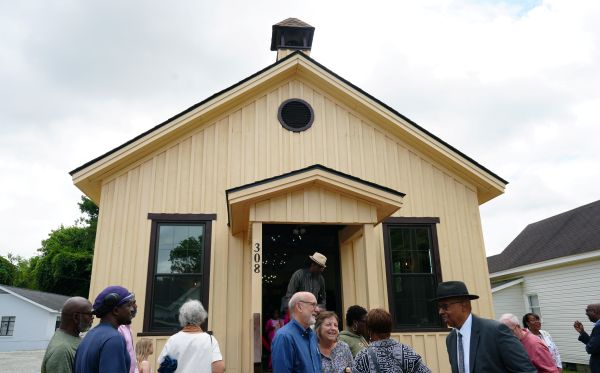 The dedication included tours of the restored schoolhouse.
But within four months of the women’s arrival, a fire burned the school to the ground, said Sanders, who's convinced that it was arson.
“A friend of mine has documented 631 African American schoolhouses across the South that were destroyed between 1864 and 1876,” she said.
“The destruction of these places of learning could have discouraged Black educational efforts,” Sanders continued. “But Black people in and around Smithfield refused to give up. The day after the fire, classes resumed in private homes.”
Black people then built anew, Sanders said.
“This time, they built on town property, perhaps believing the new location would offer greater protection,” she said.
The Freedmen’s Bureau arrived in 1868.
“The bureau only supported Black education in places where formerly enslaved people were already actively involved,” Sanders said. “This schoolhouse would not have existed had bureau officials not recognized the initiative, sacrifice, and determination of African Americans in this community.”
Between 1867 and 1871, several white teachers affiliated with the American Missionary Association moved to Smithfield and taught in the Freedmen’s Schoolhouse.
“From their surviving letters, we know that African Americans living in and around Smithfield deeply valued education,” Sanders said.
One letter, written by Susan Haines in September 1868, describes just how hungry freed people were for both education and religious instruction.
In that letter, Haines wrote: “As I enter my schoolroom Sabbath mornings and see the men, women, and children gathered there, so eager to learn the Word of God, and remember that I am the only one to whom they can look for instruction, I feel that the harvest truly is great, but the laborers still few.”
She went on to describe elderly men and women walking miles to attend classes and worship services, often bringing their children and grandchildren with them.
“What this teacher described was the determination and aspiration of a people who knew they had been robbed of literacy,” Sanders said.
Over the years, Sanders said, the Smithfield school would educate the four children of Wesley and Constantia Bell, her great-great-grandparents, both of whom had been born into slavery.
“Although Wesley and Constantia were denied an education, they made certain that their children would not be,” Sanders said. “Walking miles along muddy country roads, these children embodied the determination of African Americans to become an educated people.”
Census records show that all four children learned to read and write, Sanders said. “I am a direct beneficiary of the instruction and acquisition of knowledge that took place in this schoolhouse,” she said.
Black parents like the Bells “gave their time, talent and treasure” to build, maintain and operate schools like the one in Smithfield, Sanders said.
“When we visit this Freedmen's Schoolhouse … we should remember that education was a hard-fought freedom,” she said.
“Learning to read and write should not simply be viewed as a rite of passage,” Sanders added. “It should be understood as a powerful symbol of freedom.”
The dedication ceremony took place on Juneteenth, which marks the day in 1865 when Union troops arrived in Galveston, Texas, to announce that the Civil War was over and that enslaved African Americans were free.
“I can think of no greater expression of freedom than the ability to learn, to read, and to write,” Sanders said. “Education was proof of humanity for formerly enslaved people. It was protection against exploitation and a pathway to economic opportunity.”
Page last updated on: July 13, 2026